


Tucked beneath the limestone cliffs of Phà Hùng Mountain in Cao Bằng Province, Phia Thap Village — locally written as Phia Thắp, in Phúc Sen Commune, Quảng Hòa District — is surrounded by fields of corn and banana trees. A setting so quietly beautiful it barely seems real. Yet what makes this village truly extraordinary lies not in its scenery, but in a centuries-old craft that perfumes the air from the moment you step foot inside.
Here are eight things that most visitors never know about Phia Thap Village.
1. Nobody knows who started it.
The incense-making tradition of the Nùng An people has existed for generations, yet no one knows who the original founder was or when exactly the craft came to the village. This mystery gives Phia Thap an almost mythological quality — a craft passed down through touch and memory, not written record.
2. Every single household makes incense.
This is not a craft practised by a few artisan families. Of the 53 households in the village, all 53 make incense by hand. From young children to grandmothers, every generation participates in the production process. Incense-making here is not a livelihood, it is a way of life.
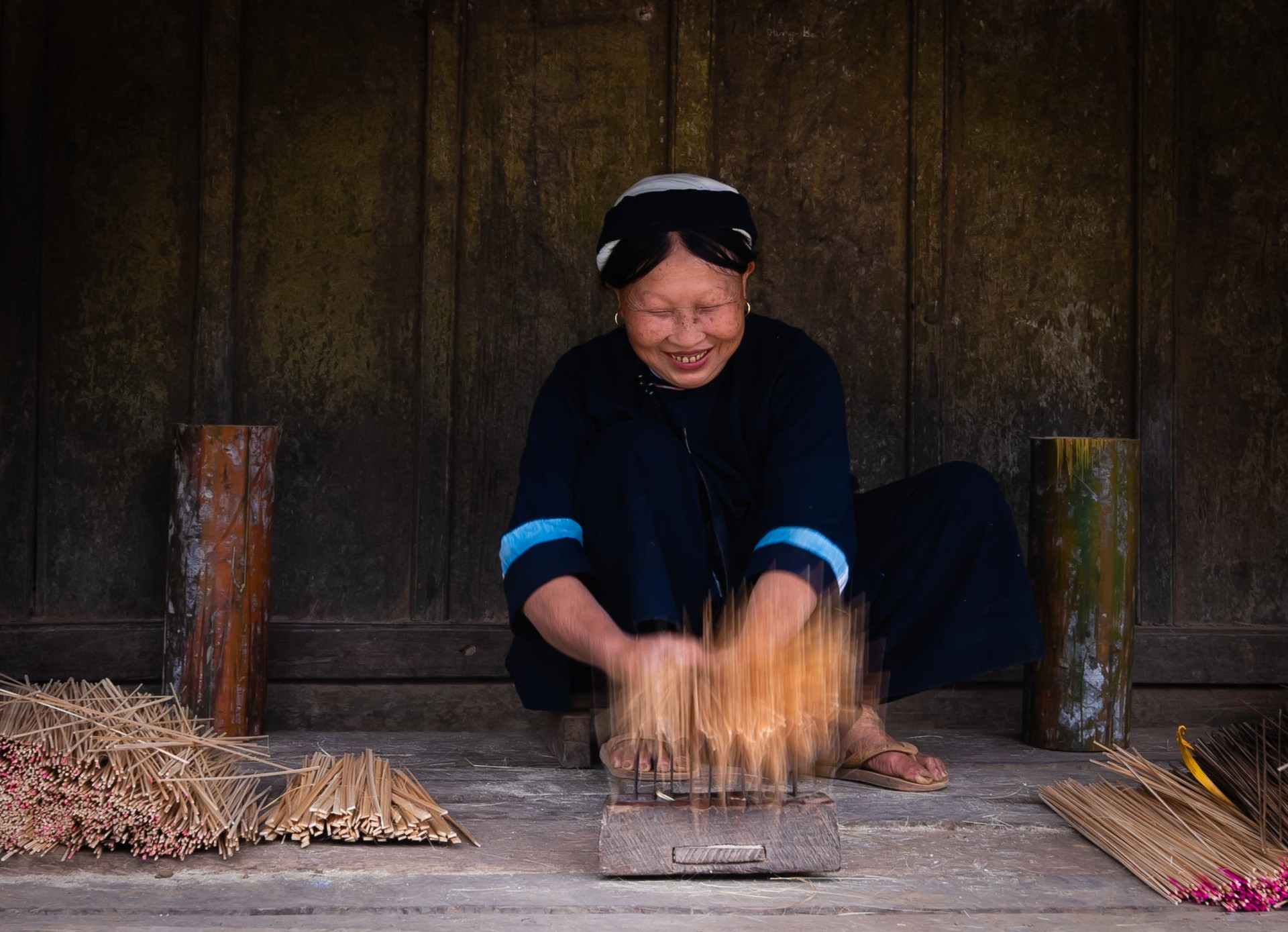
3. The secret ingredient only grows on cliff faces.
What sets Phia Thap Village incense apart from every other variety in Vietnam is a wild forest leaf called bầu hắt. Villagers venture into the forest to harvest this leaf, which grows naturally on rocky cliff faces. Dried, ground into powder, and used as a natural adhesive, it binds all the other ingredients together without a single drop of chemicals. After harvesting, the bầu hắt tree must be cut back and takes two to three years to regenerate — a natural rhythm that quietly limits production and keeps the craft from becoming industrial.
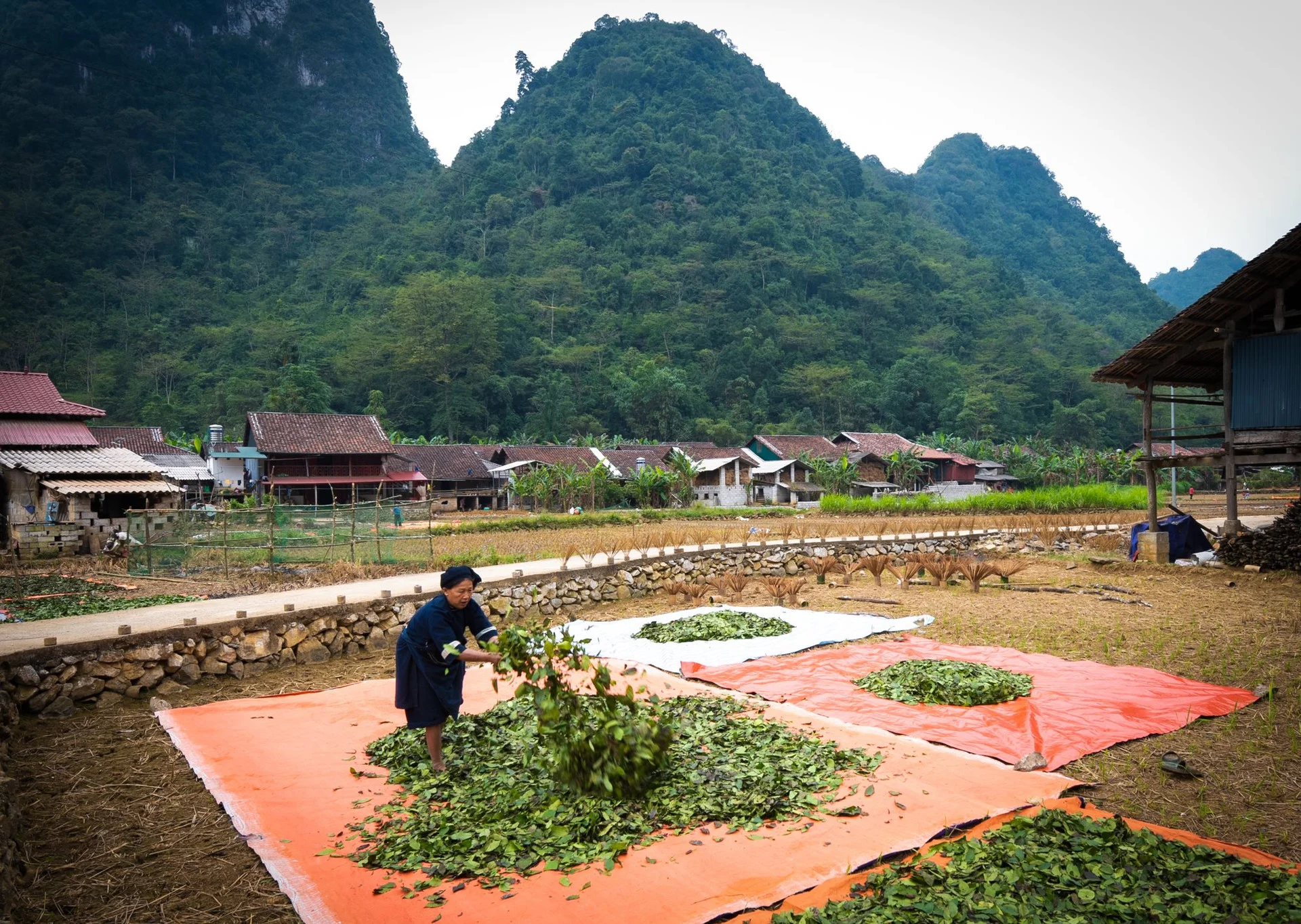
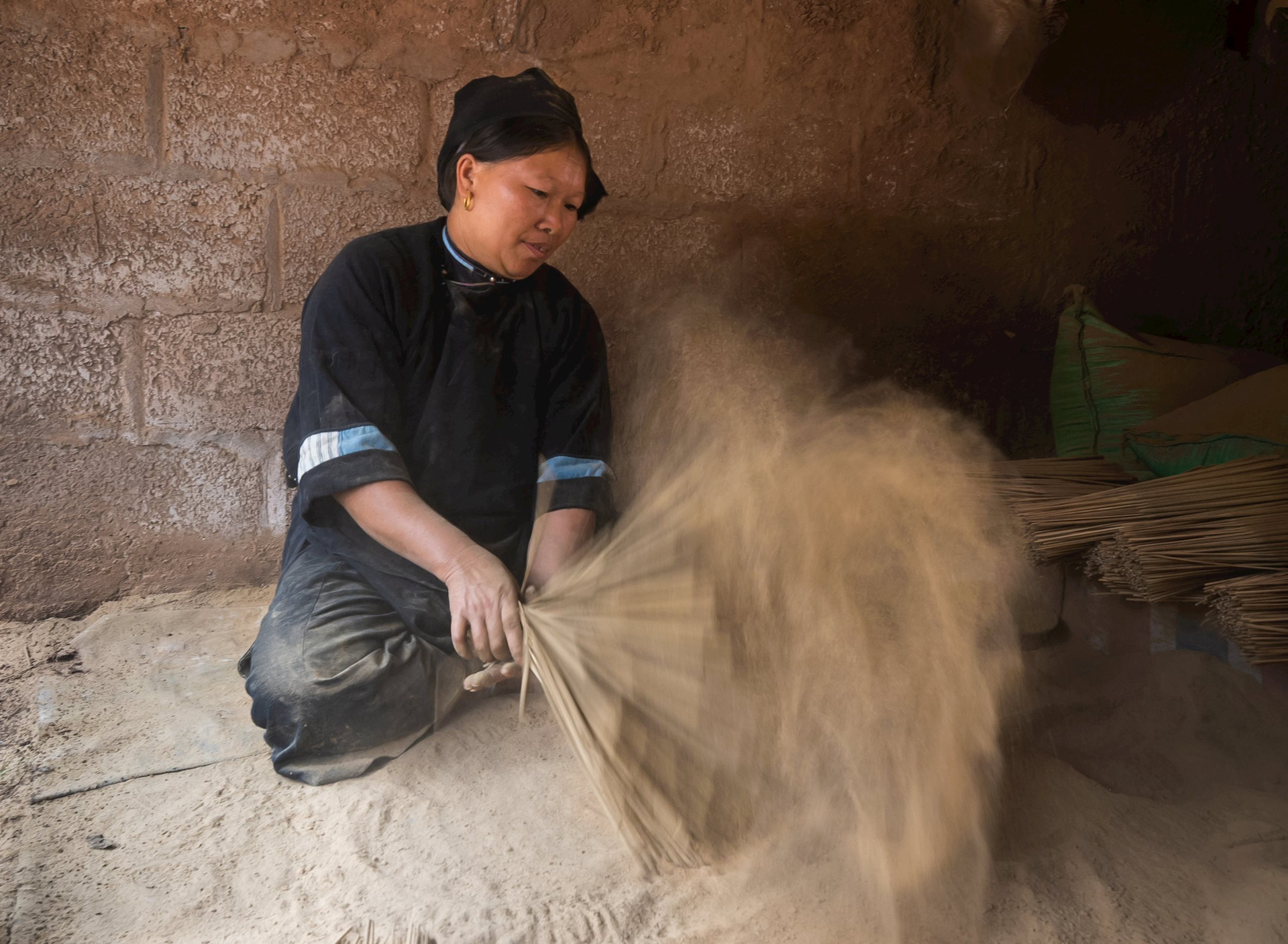
4. The pine wood must rot for at least three years.
Pine trunks are left to decompose for a minimum of three years before being chopped, dried, and ground into powder — the base material for the incense body. This slow, deliberate process cannot be rushed, and the resulting incense carries a depth of fragrance that machine-made varieties simply cannot replicate.
5. The dye is also made from forest leaves.
Unlike most incense workshops where sticks are dyed red before being fed into a machine, at Phia Thap the red tips are applied only after the sticks are fully formed, using leaves from the chăm che plant grown around the homes. The result is a living red — organic, impermanent, and quietly symbolic.
6. The whole village becomes a drying rack.
Once the incense is rolled, it cannot be kiln-dried or machine-finished. The Nùng An people use every available surface — rice paddies after harvest, pathways into the village, and stone trays beneath the stilt houses — to dry the sticks in the open air. A sunny day dries them in hours; a cloudy stretch can mean three days of waiting. Walking through Phia Thap Village during drying season, with bundles of incense fanning out in every direction, is one of the most visually arresting experiences in northern Vietnam.
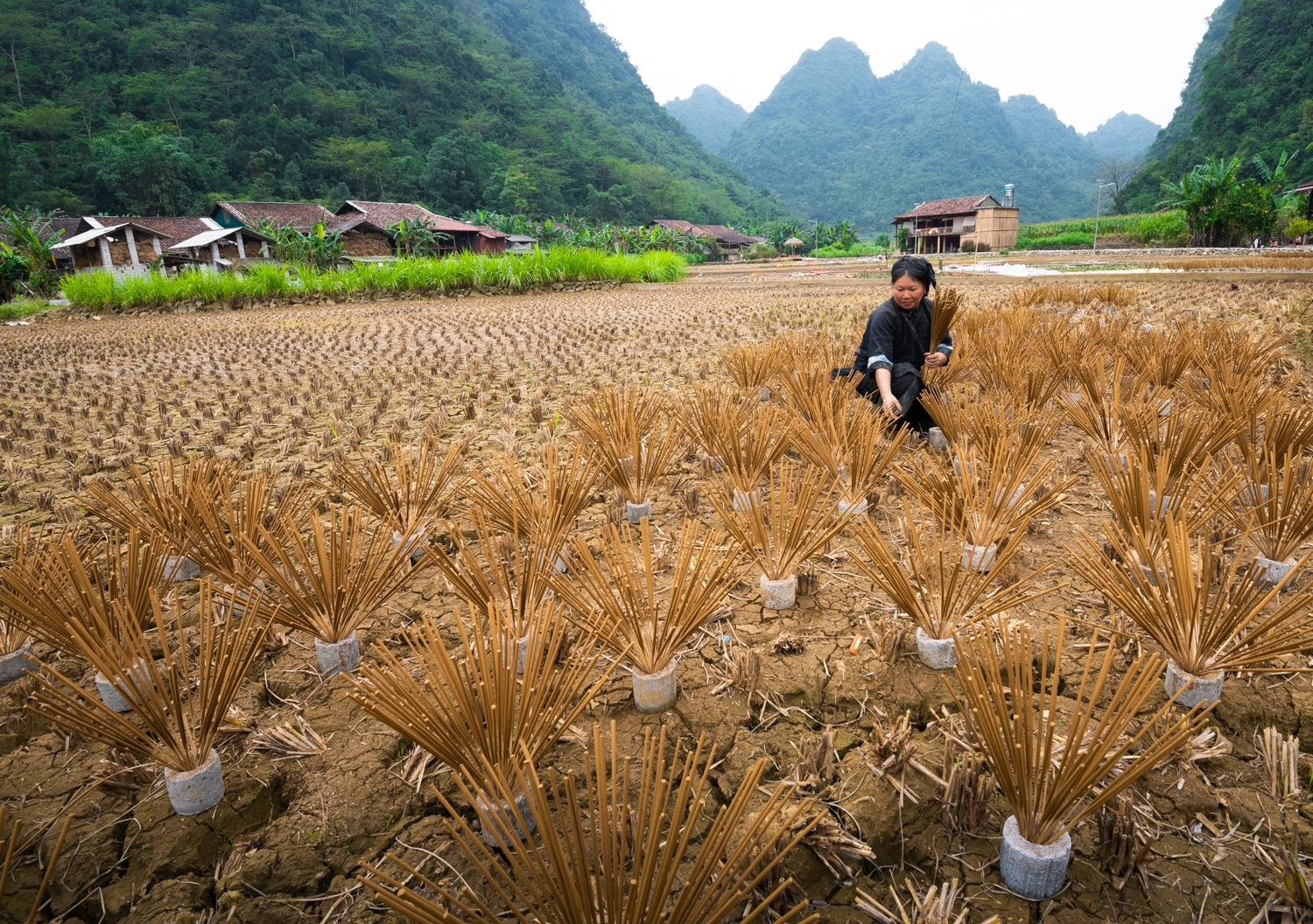
7. It is one of Cao Bằng’s officially recognised traditional craft villages — and only recently.
Phia Thap Village was selected in 2016 as one of seven hamlets in the province to develop community-based tourism, and was officially recognised as a traditional craft village by the Cao Bằng provincial government in 2021. Despite its deep history, this formal recognition is very new — and the village is still finding its footing as a destination. Visitors who come now are among the first to experience it before mass tourism arrives.
8. The rooftops tell a philosophy, not just a style.
Step back and look up. The stilt houses of Phia Thap Village are crowned with a roofing pattern found nowhere else in the Vietnamese lowlands — the ngói âm dương, or yin-yang tile roof. This is a defining feature of Tày-Nùng stilt house architecture across Cao Bằng, Bắc Kạn, and Lạng Sơn, but in Phia Thap it takes on a quiet symbolism that feels almost deliberate: a village devoted to incense — an object of spiritual offering — sheltered beneath a roof that literally embodies the balance between opposing forces.
The yin tile is concave, curving downward; the yang tile convex, arching up. The two are laid in alternating rows, interlocking across the entire roof surface. What looks from the outside like a rippling wave is, in fact, an ancient engineering solution: the hollow space created between the concave and convex tiles acts as a natural air channel, keeping the interior cool in summer and warm in winter, while allowing rainwater to drain efficiently even during heavy downpours.
Viewed from above — or from the limestone ridge above the village — the rooftops of Phia Thap emerge through morning mist like a faded ink painting, grey-brown tiles rippling in unison across the hillside. It is one of those rare architectural sights that only reveals itself at a distance, and only at the right hour.
Beyond function, the yin-yang roof carries deep cultural meaning — the concave yin tile representing the cool, dark, and receptive; the convex yang tile the warm, bright, and active. Together, they express a philosophy of balance: neither force dominates, and it is only in their union that the structure holds. In a village where every household tends fire daily — drying incense, burning wood, keeping kilns warm — the idea of balance between opposing energies is not abstract. It is the rhythm of daily life.
Why this matters for responsible travel.
Traditional incense now faces stiff competition from industrial products with modern designs and lower price points, while key raw materials grow increasingly scarce in the surrounding forest. Choosing to visit Phia Thap Village, buy a bundle of incense directly from a family, or try your hand at rolling a stick under their guidance is not just a travel experience — it is a small act of cultural preservation. The craft generates an average annual income of around 58 million VND per person, and tourism is now a meaningful part of keeping that number sustainable.
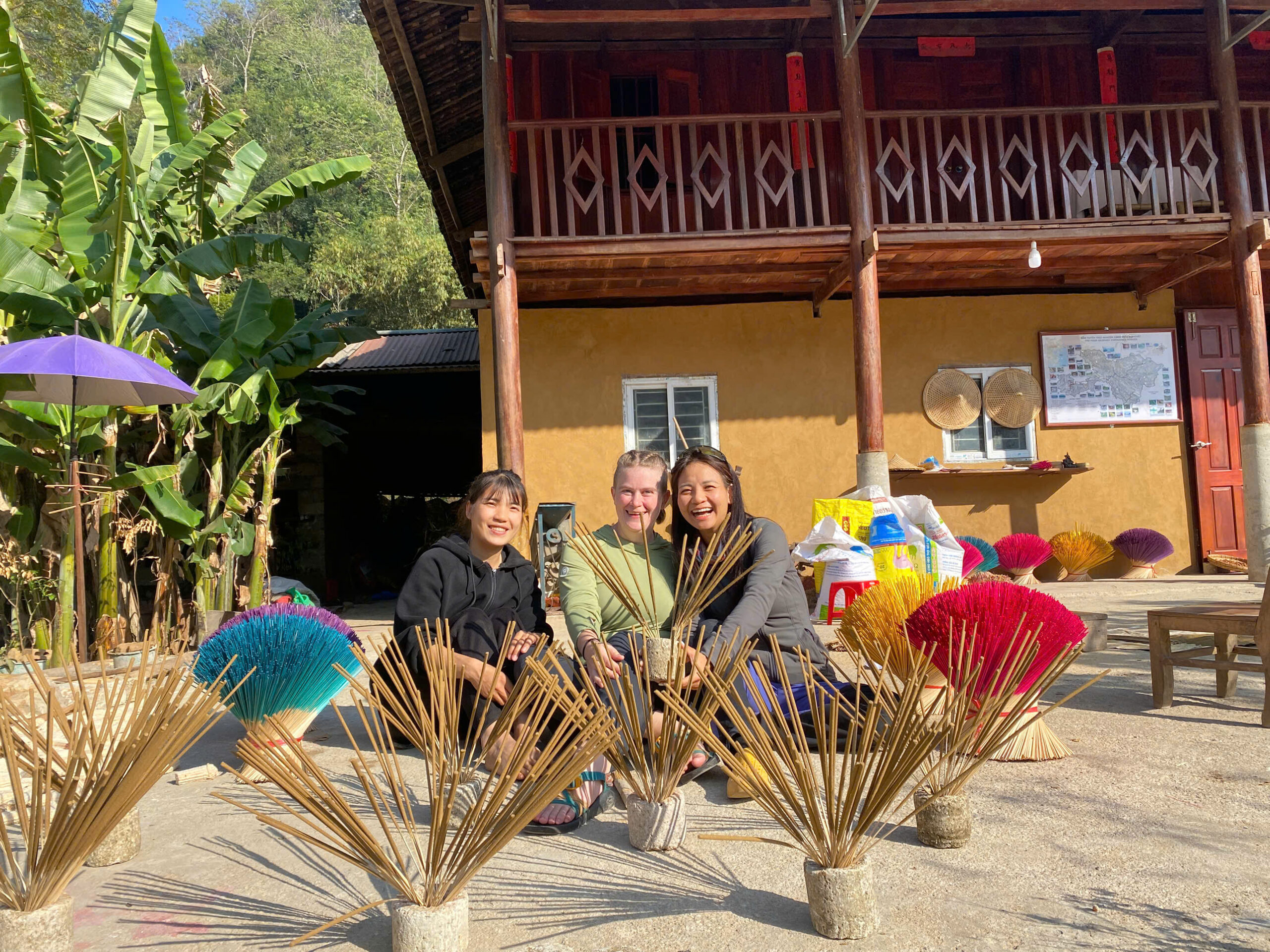
The smoke from a Phia Thap incense stick carries more than fragrance. It carries a story that no one quite knows the beginning of — and that is worth the journey.
Phia Thap Village is located approximately 26 km from Cao Bằng city, along the road toward Trùng Khánh District.